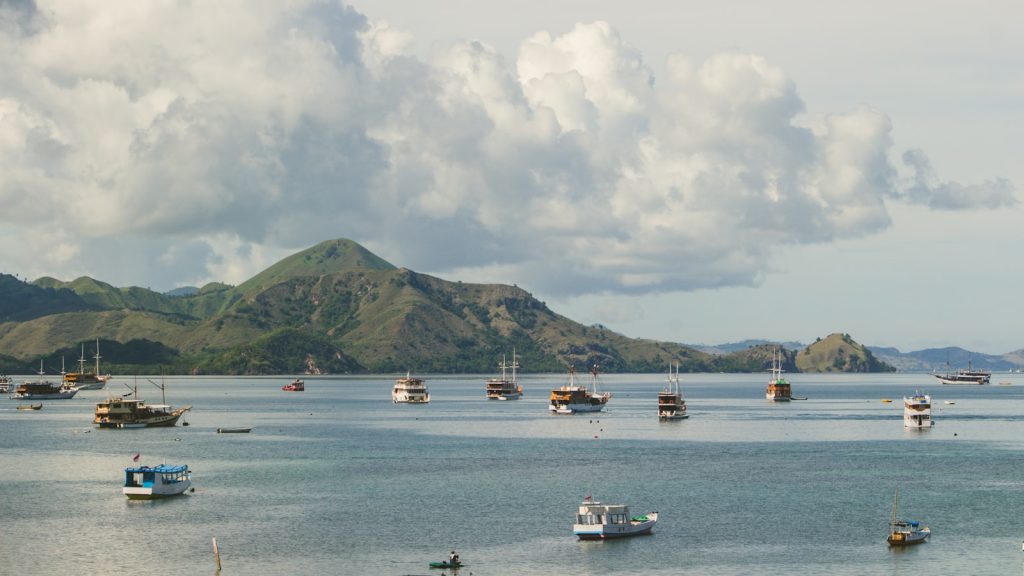
Komodo National Park fees for liveaboards are the per-guest and per-vessel charges levied by the park authority every time a charter boat enters and operates within the protected area — a componentised structure covering visitor entrance, conservation contribution, diving access, ranger or trekking fees, and a vessel day-use charge. At current approximate rates, a foreign guest on a dive liveaboard faces a combined park-fee contribution of roughly IDR 400,000–500,000 per day as operators commonly bundle the components; verify that figure against the current published park schedule before quoting it to any guest, because it has changed before and will change again.
That first paragraph contains the most important piece of advice in this article: the tariff changes. It changed in 2019. It was proposed to change dramatically in 2022. The proposal was suspended. It will change again. For liveaboard owners and operators, Komodo park fees are not a stable line item to budget once and forget — they are a recurring governance risk to price in from the first day you model the business.
This piece breaks down what you actually pay, in what components, and then tells the verified story of the IDR 3.75M per-person scheme — not because that figure is current, but because understanding why it was proposed, what happened to it, and what it revealed about the park’s governance trajectory is exactly what an owner needs to know before signing a 20-year charter vessel investment.
The Fee Structure: Components You Are Actually Paying
The Komodo National Park fee structure is not a single flat entrance charge. It is built from several separate tariff lines, each with its own authority, rate, and revision cycle. Operators typically add these up and quote a bundled per-guest daily figure, which is why many charter guests see one number on their trip briefing. The breakdown below is approximate and reflects the structure as it applied broadly through 2023–2025 — verify every figure directly with the park authority (Balai Taman Nasional Komodo) before using it in a cost model or guest quote.
Foreign Visitor Entrance and Conservation Fee
This is the base charge to enter the park as a foreign national. It includes what the park terms a conservation contribution — the portion notionally directed at ranger operations, habitat protection, and patrol activities. The approximate current rates:
| Day Type | Approximate Rate per Foreign Visitor | Confidence |
|---|---|---|
| Weekday | IDR 150,000 – 200,000 per day | APPROXIMATE — verify current schedule |
| Weekend / public holiday | IDR 225,000 – 275,000 per day | APPROXIMATE — verify current schedule |
Indonesian domestic visitors pay a lower rate. For a liveaboard carrying predominantly international guests — the norm in the foreign-language charter market — this base fee applies to essentially every guest on every park day. On a standard five-day Komodo itinerary, the base entrance component alone runs IDR 750,000–1,000,000 per foreign guest before any activity supplements.
Diving Access Supplement
Guests who dive pay an additional fee per diving day inside the park. Approximate current rate: IDR 100,000–150,000 per guest per diving day. This is separate from the entrance fee; a guest who dives every day of a five-day itinerary accumulates IDR 500,000–750,000 in diving supplements on top of the base entrance charge.
Snorkelling guests may fall under a different or reduced supplement — confirm this distinction with the park directly, as the applied rate has not been consistently defined in the publicly available tariff documentation we have reviewed.
Ranger and Trekking Fee
Guests who go ashore to trek — Rinca, Padar, the Komodo Island viewpoints — pay a ranger escort fee per landing. Approximate rate: IDR 80,000–150,000 per visitor per visit. Rangers are mandatory for all trekking within the park; this is not an optional upgrade.
A liveaboard itinerary that includes two or three island landings per guest accumulates IDR 160,000–450,000 per guest in ranger fees across the trip. Operators who run full trekking programmes (sunrise hikes, multiple viewpoints, Rinca komodo-spotting) face the higher end of this range repeatedly across a season.
Vessel Entry Fee
The vessel itself — not just its passengers — is charged a daily entry fee for operating within park waters. Approximate rate: IDR 100,000–200,000 per vessel per day. For a liveaboard spending five days in the park on a typical itinerary, the vessel entry charge is IDR 500,000–1,000,000 per trip — modest relative to the per-guest charges but worth tracking as a distinct OPEX line.
How Operators Bundle These Components
Rather than itemising each fee on a guest invoice, most liveaboard operators aggregate the components and charge a daily park-fee contribution per foreign guest. The commonly reported operator practice is a bundled rate of IDR 400,000–500,000 per foreign guest per day for dive liveaboards, covering entrance, conservation, diving supplement, and a share of the vessel and ranger fees.
That bundled range is based on observed operator practice — it is not a published official rate. Operators at different price tiers and with different trip structures (more or fewer island landings, different guest-to-vessel ratios) arrive at different numbers. Some high-end operators pass the components separately and transparently; others absorb them into the headline charter price. Neither approach is wrong, but if you are modelling a new operation, use the components above to build your own estimate rather than adopting a bundled figure without checking whether it still matches current tariffs.
On a 10-guest, five-day trip entirely within the park:
- Base entrance + conservation (weekdays)
- IDR 150,000–200,000 × 10 guests × 5 days = IDR 7,500,000–10,000,000
- Diving supplement (all guests, all days)
- IDR 100,000–150,000 × 10 × 5 = IDR 5,000,000–7,500,000
- Ranger fees (two island landings per guest)
- IDR 80,000–150,000 × 10 × 2 = IDR 1,600,000–3,000,000
- Vessel entry fee
- IDR 100,000–200,000 × 5 days = IDR 500,000–1,000,000
- Total per-trip park fee estimate
- IDR 14,600,000–21,500,000 (approximately IDR 15–22M per trip)
Against a typical revenue of IDR 100–300M+ for such a trip depending on operator tier, the park fee is a meaningful but not dominant cost — unless it doubles, which is exactly what the 2022 proposal attempted to do to individual guests.
Thinking through the full fee structure for a specific operation? Reach out via our enquiry form or WhatsApp — we can help you build an honest operating-cost model before you commit.
The IDR 3.75M Saga: What Actually Happened
In mid-2022, news spread through the Indonesian charter industry that Komodo National Park was proposing a new fee scheme: IDR 3,750,000 per person per visit — roughly USD 250 at the time. This was not an incremental adjustment. It was a proposed increase of more than ten times the existing per-visitor rates, framed by proponents as a conservation finance tool and a demand-management lever to reduce visitor numbers at ecologically stressed sites like Komodo Island and Padar.
The proposal was formally announced by the East Nusa Tenggara provincial government and the Ministry of Environment and Forestry (KLHK), with an initial implementation window discussed for August 2022. The IDR 3.75M figure was to cover a bundled “Komodo Conservation Premium” — the government’s framing was that the park was being loved to death and that a sharp price increase would both fund conservation and self-select for higher-spending, lower-volume visitors.
The Industry Pushback
The response from the local charter and tourism industry was swift and loud. Liveaboard operators, dive shop owners, local guides, hotel associations in Labuan Bajo, and international tour operators all pushed back, for different but overlapping reasons:
- Viability of the mid-market. A five-day, 10-guest trip at IDR 3.75M per person adds IDR 37.5M in park fees per trip — on top of existing vessel and activity charges. For budget-to-mid operators whose all-in charter price sat in the IDR 150,000–300,000 per person per day range, a fee of this magnitude was not absorbable. It would either kill their business model or force them to pass the cost directly to guests in a segment already sensitive to price increases.
- Competitive displacement. A significant share of the international market comparing Indonesia with the Maldives, the Philippines, or Australia’s Coral Sea would recalibrate at a premium Komodo price point with a still-developing infrastructure — the destination is world-class but Labuan Bajo is not yet Malé or Cairns in terms of logistics.
- Local livelihood impact. Guides, rangers, boat crew, local food suppliers, and onshore accommodation all benefit from visitor volumes. A demand-reduction strategy was a different kind of cost, carried disproportionately by lower-income residents of Labuan Bajo and Manggarai.
- Implementation opacity. The proposed scheme lacked clear published rules on what the fee covered, how it would be administered, and where the revenue would go. Industry representatives described being unable to get a definitive fee schedule in writing before the proposed launch date.
Protests, industry association letters, and public debate followed. The national government, through the coordinating ministry, intervened.
The Postponement
The IDR 3.75M scheme was postponed before it took effect. The national government deferred implementation pending further consultation — effectively shelving the proposal in response to industry and public pressure. As of 2025, the scheme was not in force. The existing, lower-rate componentised structure described in the previous section continued to apply.
This is a verified fact: the IDR 3.75M per-person fee was announced, contested, and suspended. It was not implemented. Any article or operator quoting IDR 3.75M as a current Komodo entrance fee is citing a proposal that did not become policy.
That said, the proposal did not disappear because the underlying logic was rejected. The park genuinely faces conservation-finance pressure, the Komodo Island komodo dragon population does face visitor-load management challenges, and the question of how to fund world-class conservation from a domestic tourism authority budget will not resolve itself. A revised premium scheme — at a lower figure, with cleaner implementation, or applied differently — remains a structural possibility. The 2022 saga is a data point about the direction of policy intent, not a reassurance that the fee level is stable.
Why Fee Volatility Is a Structural Business Risk — Not a Nuisance
Most analyses of Komodo liveaboard economics treat park fees as a minor cost line — something to include in the spreadsheet and move on from. That framing misses what the 2022 episode revealed about the governance structure.
Park fees in Komodo are set by decree, not by a commercial negotiation you can influence. The timeline from announcement to proposed implementation in 2022 was weeks, not years. An operator who had sold forward bookings at a given all-in price — which is how the liveaboard market works, with charters booked six to eighteen months in advance — faced the prospect of absorbing a fee shock mid-season or repricing clients who had already paid deposits.
Three facts define the structural risk:
- You cannot hedge it. There is no instrument to lock in future park fee costs the way you might hedge fuel exposure through supply contracts. If fees rise after your bookings are sold, you either absorb the increase or create a client-relations problem.
- It can move in large steps. The 2022 proposal was not a 10% or 20% increase — it was a ten-times increase. Regulatory increments in national park fees in Indonesia have historically been irregular: years of stability followed by sharp jumps when a new decree is issued.
- Adjacent parks follow the same pattern. Raja Ampat introduced new permit fees and zoning restrictions in its own regulatory cycle. Operators who reposition between Komodo and Raja Ampat in seasonal rotation face fee volatility at both ends of the route. The Banda Sea and Alor corridor have their own permit structures. There is no Indonesian marine tourism zone where this governance dynamic does not apply.
The practical implication for operators: build a fee-volatility buffer into your all-in pricing rather than operating on the assumption that current rates are permanent. A realistic buffer of 20–40% on the park fee component — not on the overall charter price, but on the park-fee line — gives you room to absorb a moderate increase without repricing existing bookings. On a bundled IDR 400,000–500,000 per guest per day, that buffer is IDR 80,000–200,000 per guest per day: a margin line, not a dramatic premium.
For prospective owners buying or commissioning a boat today: the financial model should show park fees at current approximate rates, and separately show what happens to the business case if fees double. If the business only makes sense at current rates, that is a risk worth naming before you invest.
What Operators Must Verify — and When
The practical compliance question for a Komodo liveaboard is not just “what is the fee?” but “am I paying it correctly, to the right authority, with the right documentation?” Several things are worth confirming before each season:
The Current Published Tariff Schedule
Obtain the current official tariff document from Balai Taman Nasional Komodo — the park management authority — before each operating season. Do not rely on last year’s briefing, a WhatsApp forward from another operator, or anything published on a travel website. The official published rate is the one that counts in a fee dispute or inspection. If no current written schedule is available from the park office, that absence itself is information worth noting when you plan your pricing.
Seasonal and Day-Type Distinctions
The weekday/weekend differential described above means that an itinerary running primarily over a weekend accumulates higher fees than the same itinerary mid-week. For an operator building annual projections, this distinction matters if the peak-season booking profile skews toward Friday-Sunday departures — which is common in the domestic market.
Indonesian Domestic vs Foreign Guest Rates
Indonesian nationals pay lower park entrance rates than foreign visitors. On a boat carrying a mixed Indonesian/international manifest — common on open-trip vessels targeting both markets — the per-guest fee calculation is not uniform. The split matters for guest invoicing and for operator cost projection when the domestic market grows as a proportion of business.
New or Amended Permit Requirements
Beyond entrance fees, liveaboard operators require a TDUP (Tanda Daftar Usaha Pariwisata — Tourism Business Registration Certificate) or an equivalent operating permit for commercial marine tourism. This is separate from vessel registration and certification. Komodo NP has periodically reviewed what additional environmental or operational permits it requires of commercial operators — particularly for activities at sensitive dive sites. Confirm annually whether any new permit category has been introduced that applies to your vessel type or operating area.
Boat Quota or Entry Cap Announcements
Separately from fees, there have been periodic discussions about capping the number of charter vessels permitted to operate in the park — a quantity restriction rather than a price restriction. The political economy of this is different from a fee change (cap announcements create asset value for existing permit-holders, while fee increases impose costs on all operators equally), but the effect on new entrants is similar: entry barriers rise. An operator buying into the Komodo market now should verify the current status of any quota or permit-cap framework before assuming unlimited access is guaranteed by purchasing a boat.
The Operating-Cost Context: Where Park Fees Sit in the Bigger Picture
For a working Komodo liveaboard, park fees are a significant but not dominant operating cost. To put the numbers in perspective against the full annual cost structure of running such a vessel:
| Cost Category | Annual Estimate for a Mid-Tier 30m Boat | Notes |
|---|---|---|
| Crew payroll (12 crew) | IDR 540M – 840M | Estimate; no official wage table |
| Maintenance + dry dock | IDR 160M – 400M | Wooden hull; 3–8 weeks yard time/year |
| Insurance (H&M + P&I) | IDR 100M – 250M | 1.5–4% hull value + P&I estimate |
| Fuel (engine + genset) | IDR 150M – 300M | 130 charter days, mid-tier burn |
| Mooring and harbour dues | IDR 30M – 80M | Confirm with KSOP / Pelindo Labuan Bajo |
| Komodo NP fees (pass-through or bundled) | IDR 60M – 130M (10 guests, 130 days) | Approximate; verify current park schedule |
| Food provisioning | IDR 200M – 400M | 130 days × 10 guests |
| Licensing and certificates | IDR 20M – 80M | TDUP, BKI, annual renewals |
The park fee line — at IDR 60–130M annually for a mid-tier operation — sits below crew costs, maintenance, and fuel, but above mooring and licensing. It is material. And uniquely among these cost lines, it can jump by a decree that you have no seat at the table to influence.
For a full breakdown of phinisi operating costs across all categories, see our operating costs pillar — it covers crew salaries, dry dock, insurance, fuel burn, and mooring in the same numbers-first format.
A Note on Independent Reporting
Most park-fee information published online comes from one of three sources: the park authority itself (official but not always current in published form), tour operators (whose interest is in presenting competitive all-in prices), or travel media (which often republishes operator figures without independent verification). We are not any of those things.
The figures in this article are sourced from public tariff documentation, industry practice as reported across multiple operators, and direct observation of how the fee structure has been applied. Where a figure is approximate, we have said so. Where a figure requires verification, we have told you who to ask. No one has paid for any of these figures to be framed a particular way. If you use our free help and proceed with a partner or operator, they may pay us a referral fee at no extra cost to you — but that has no bearing on what the park charges or what we write about it.
If you are modelling a Komodo liveaboard operation and want to pressure-test the numbers, reach out via our enquiry form or WhatsApp. We are happy to work through the fee components with you against a specific itinerary and vessel type.
Frequently Asked Questions
What are the current Komodo National Park fees for foreign visitors on liveaboards?
The current structure is componentised, not a single flat fee. Foreign visitors pay approximately IDR 150,000–200,000 per day on weekdays (IDR 225,000–275,000 on weekends) for entrance and conservation, plus approximately IDR 100,000–150,000 per diving day, plus IDR 80,000–150,000 per island trekking visit. The vessel pays a separate entry fee of approximately IDR 100,000–200,000 per day. Operators commonly bundle these at IDR 400,000–500,000 per foreign guest per day for dive liveaboards. All figures are approximate — verify the current official schedule with Balai Taman Nasional Komodo before quoting guests or building a cost model, as tariffs change.
Is the IDR 3.75M Komodo entrance fee in effect?
No. The IDR 3.75M per-person scheme was announced in 2022 as a proposed conservation premium, generated significant industry pushback, and was postponed before taking effect. As of 2025, it was not implemented. The lower, componentised fee structure described above applies. However, the underlying policy intent — raising fees to fund conservation and manage visitor volumes — has not been abandoned. Future fee increases, potentially at a lower figure than the original IDR 3.75M proposal, remain a genuine possibility. Any article or booking platform citing IDR 3.75M as a current fee is referencing a proposal that did not become law.
How should liveaboard operators budget for Komodo park fee volatility?
Build a volatility buffer into your pricing rather than treating current rates as permanent. Practically, this means pricing park-fee pass-through with a 20–40% buffer above current rates on the fee line itself (not the overall charter price), reviewing your tariff documentation directly with the park authority before each operating season, and stress-testing your financial model against a scenario where fees double — because that is roughly what the 2022 proposal would have done. Liveaboard bookings are typically sold six to eighteen months in advance; if fees rise mid-season after deposits are paid, your options are to absorb the increase or create client-relations friction. There is no financial instrument to hedge this risk.
Do Indonesian domestic visitors pay the same Komodo park fees as foreign guests?
No. Indonesian nationals pay lower entrance rates than foreign visitors. The differential matters for operators running open-trip vessels that mix domestic and international guests, since the per-guest fee calculation is not uniform across the manifest. Verify the current domestic rate with the park authority alongside the foreign rate — both can change independently in a tariff revision.
Does Komodo National Park have a boat quota or entry cap for liveaboards?
The park has had periodic discussions about capping the number of commercial vessels permitted to operate within its boundaries, distinct from fee changes. As of mid-2025, no confirmed hard cap on liveaboard vessel numbers had been publicly implemented, but the policy discussion continues and the situation can change. Before buying or commissioning a vessel specifically for Komodo operations, confirm directly with the park authority and KSOP Labuan Bajo whether any permit quota or vessel-cap framework is in effect or imminent. Acquiring a vessel under the assumption of unlimited access, and then facing a future permit restriction, would be a costly miscalculation.