Information, not advice: Phinisi Owner is an independent editorial guide — not a shipyard, broker, surveyor, or licensed adviser. Costs and regulations change and every vessel differs; verify figures with yards, independent surveyors, and licensed Indonesian counsel before committing money. If you engage a partner we introduce, that partner may pay us a referral fee at no cost to you.
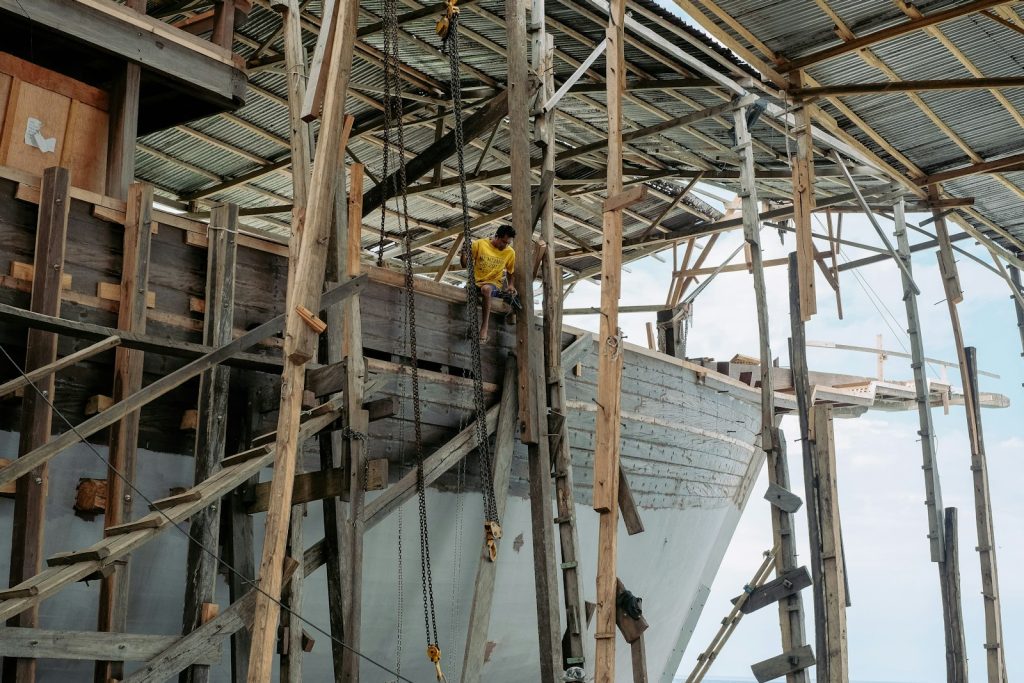
To build a phinisi in Indonesia is to commission a wooden sailing vessel from the boatbuilding communities of South Sulawesi — principally the yards at Tana Beru, Ara, and Bira in Bulukumba Regency — using centuries-old construction methods that UNESCO inscribed in 2017 as Pinisi, art of boatbuilding in South Sulawesi. The craft is genuinely remarkable: the panrita lopi (master builder, also called punggawa) sets every dimension — keel length, frame spacing, plank scantlings — from memory and eye, without blueprints. What makes the process hard for outside buyers is exactly what makes it distinctive: the knowledge is oral, the contracts are often trust-based, and quality control falls almost entirely on whoever is paying the bill.
This guide walks the full arc: brief and budget, yard selection, contract and payment structure, timber sourcing, keel ceremony, the planking period, launch, and the long tow to fit-out. It is written from the yard side, not the sales deck. Every cost bracket is flagged as an estimate unless anchored to a verified source. Timeline figures are ranges, not promises. You will not find a yard recommendation here — that is not what independent editorial does.
Before You Commission: Brief, Budget, and the Hull-Cost Illusion
The most persistent misunderstanding in phinisi commissioning is treating the hull quote as the project budget. It is not. The hull is structurally inexpensive relative to total project cost — that is one of the defining economic features of Sulawesi boatbuilding. Naval architect Michael Kasten, who designed Silolona, Dunia Baru, and Amandira, puts it plainly on kastenmarine.com: quality control is the core challenge of phinisi building, and the low structural cost masks the true scope of what a seaworthy, commercially operable vessel requires.
The starkest data point on record: the hull and superstructure contract for the 51-metre Dunia Baru was USD 130,000 from the Konjo builders of Sulawesi — plus roughly USD 100,000 of fastenings and bolts that the owner discovered were not included in that quote. Owner Mark Robba told Boat International that he had modelled USD 1 million total; the final cost after an eight-year project was approximately six times that. The hull was less than ten percent of the bill. Machinery, navigation and electrical systems, interior joinery, project management, and the perpetual cost of unsupervised delays consumed the rest.
None of this means commissioning a phinisi is the wrong decision. It means your brief needs to answer several questions before a yard conversation begins:
- Commercial or private? A charter-grade vessel requires BKI class certification, a passenger safety certificate, and correct tonnage measurement. A private cruising yacht does not — but if you ever want to charter commercially in Indonesian waters, the flag and certification regime applies from the moment passengers board.
- Hull-only or turnkey? A Sulawesi yard can deliver a launched, unpainted, unengined hull. Everything from that point — engines, generators, watermakers, electrical, plumbing, helm station, interior, safety equipment, rig, and final survey — happens elsewhere, almost always in Bali (Benoa/Serangan), Surabaya, or Jakarta. Budget for that second project before you sign anything in Bulukumba.
- What size, and why? Length drives crew size, port fees, park levies, and minimum certification requirements. A 25-metre open-trip boat and a 40-metre eight-cabin liveaboard have different economics at every stage. Engage a naval architect before fixing on a length — scantlings, stability calculation, and the weight of systems all need to be worked through by someone qualified.
Commonly quoted turnkey ranges — flagged as industry estimates with no audited source — run from roughly USD 120,000–400,000 for a basic 20–30-metre open-trip build at local standard, through USD 400,000–900,000 for a 30–35-metre charter-grade vessel, to USD 1–2 million for a 35–40-metre Western-specification build. Above 40 metres, superyacht-grade costs begin at roughly USD 3 million and can exceed USD 7 million for ultra-luxury tonnage. The 55–65-metre flagship tier — Lamima, Prana by Atzaro — involves fit-out budgets that have never been publicly confirmed; any figure you see online for those projects is unverified.
If the hull cost is what draws you in, use it as a starting point, not a ceiling.
Yard Selection: Bulukumba, Kalimantan, and Why the Fit-Out Venue Matters
The UNESCO-recognised centre of phinisi construction is Bulukumba — specifically Tana Beru, Ara, and Bira. These three coastal villages are where the panrita lopi tradition is concentrated, where apprenticeships run within families, and where you can walk onto an active beach yard and watch frames going up. Kasten’s analysis notes that the cheapest hull venue by material cost is actually Kalimantan, where ulin ironwood (Eusideroxylon zwageri) is sourced and where some yards operate closer to the timber supply. South Sulawesi yards typically source ulin from Kalimantan by sea, adding transport cost and delivery uncertainty.
Fit-out venue is a separate decision and arguably more consequential for the final vessel. Jakarta, Surabaya, and Bali (Benoa harbour) are the three main options. Batam, near Singapore, has a duty-free advantage on imported equipment. The Lamima hull was built at Ara; the fit-out was executed in Thailand by Italthai — one of the rare cases where a Sulawesi hull crossed an international border for outfitting. That route is not common and involves Indonesian flag and customs complications that need legal advice before you commit to it.
Selecting a yard comes down to four practical questions. Can you visit during a live build and inspect the framing quality, fastener choice, and caulking standard? Does the panrita lopi have experience with the size and specification you need? What payment milestone structure will they accept in writing? And — critically — who will be present on your behalf when you cannot be there?
We do not name yards as recommendations. The right yard for a 22-metre open-trip build is not the right yard for a 45-metre charter yacht. Kasten notes that he maintains a list of builders to avoid but does not publish it. The honest answer is that yard vetting requires direct site visits, owner references from completed projects, and ideally an independent marine surveyor who has worked in Bulukumba before.
Contract and Payment Staging: Where Trust Meets Reality
Traditional phinisi commissioning was oral — an agreement between the owner’s representative and the punggawa, sealed by relationship and community standing. That model still operates, particularly for smaller builds within existing networks. For an outside buyer commissioning a vessel above 25 metres, an oral arrangement is a serious financial risk.
Modern practice has moved toward written contracts with milestone-based payments, though there is no industry-standard structure — this varies significantly by yard, builder relationship, and vessel complexity. A commonly reported structure runs approximately 20–30% at keel-laying, with further progress payments tied to frames-up, planking completion, deck-and-superstructure, and launch. Final payment is typically released at launch or on completion of agreed punch-list items. These percentages are flagged as industry-reported practice, not a verified standard; the exact structure should be negotiated and documented before any money changes hands.
Several things a contract should address that often get omitted:
- Timber specification and sourcing. Ulin ironwood is the preferred structural timber for keel, frames, and garboard planking — it is dense, resistant to teredo boring worms, and extremely durable. It is also scarce and legally controlled due to decades of over-harvesting in Kalimantan. A contract that specifies ulin but does not require documentation of legal provenance exposes you to substitution risk. Bitti (Vitex cofassus), a Sulawesi-native timber with good flexibility and moderate durability, is commonly used for curved planking and frames. Teak (jati) is standard for decks and interior structure.
- Scope definition for the hull contract. The Dunia Baru experience — USD 100,000 of bolts outside the quoted price — is not an outlier. Fastenings, chain plates, mast partners, and deck hardware are regularly treated as extras unless explicitly included. Get a line-item scope in writing.
- Delay clauses. Yard delays of six to eighteen months over schedule are common — estimate, widely reported, no formal data. Without a clause specifying either a completion date or a milestone schedule with consequence, you have no recourse and limited leverage.
- Change-order procedure. Scope changes mid-build without a written amendment are how cost overruns multiply. A 20–50% cost overrun versus initial quote is typical on loosely structured phinisi contracts (estimate, industry-reported).
Have a bilingual contract reviewed by an Indonesian maritime lawyer before signing. This is not optional for any build above roughly USD 100,000.
Timber Sourcing, Keel-Laying, and the Ritual Opening
The construction sequence begins before the first cut. Timber procurement — particularly ulin sourcing from Kalimantan — can take weeks to months depending on market availability and regulatory conditions. Green or insufficiently seasoned ulin will move after the hull is completed; the yards know this, but commercial pressure to begin work does not always allow adequate drying time. Ask specifically about seasoning practice, and factor timber lead time into your overall schedule.
Keel-laying is both a structural and ceremonial event. The panrita lopi oversees the ritual alongside the structural work — offerings are prepared, prayers offered, and the community acknowledges the beginning of a vessel’s life. For the builder, this ceremony is not decorative; it is inseparable from the craft. Do not approach it as a photo opportunity or try to accelerate through it. If you are present, show appropriate respect and let the panrita lopi set the pace.
From the UNESCO inscription: the panrita lopi is simultaneously chief designer, project manager, and ritual specialist. The knowledge of hull form — how the keel curves, how the stems are set, how the frames will be spaced to create the right sheer and sections — lives in the builder’s memory, transmitted orally across generations within boatbuilding families. There are no drawings. This is one of the inscribed cultural practices; it is also, from a quality-control perspective, precisely why independent verification matters.
Frames, Planking, and the Supervision Problem
The framing and planking period is where unsupervised builds go wrong. Kasten’s published assessment is direct: most owner-builds that proceed without qualified on-site supervision produce results that are, in his words, shockingly bad and in some cases unsafe. That is a characterisation from a naval architect with direct experience of the yards — not a generalisation from the outside.
The supervision gap is structural. The panrita lopi is managing his yard’s workflow, not optimising for your specification. Workers are skilled at traditional construction but may not be familiar with the fastening standards, waterproofing methods, or structural reinforcements that a seagoing commercial vessel needs for Western-standard insurance and certification. Fastenings are a particular vulnerability: mixed metals, undersize bolts, or insufficient number of fasteners in keel-to-frame connections are common findings on survey.
Three layers of oversight are strongly advisable for any commercial build:
- Independent build surveyor
- A marine surveyor with wooden-vessel experience, present at key milestones — frames-up, garboard planking, deck structure, launch. Their role is not to manage the yard but to document and flag deviations from agreed specification. For a 30-metre commercial build, the cost of periodic surveyor visits is small relative to the cost of a structural defect found post-launch.
- Naval architect
- Ideally involved before the build begins, to produce at minimum a lines plan and scantling specification that can be communicated to the yard. This gives you a document to survey against. A naval architect can also specify the stability calculation and structural reinforcement needed for class.
- BKI during build
- Biro Klasifikasi Indonesia (BKI) is the Indonesian classification society. If commercial charter is in scope, BKI class is effectively required for insurance and for the passenger safety certificate. BKI involvement during construction — not just at completion — creates a surveyable build record and improves the likelihood of a clean class certificate. Attempting to class a vessel retrospectively, after systems are installed and compartments closed, is significantly more expensive and often results in required modifications.
The practical challenge for foreigners supervising a phinisi build in Bira or Tana Beru is cultural and logistical, not legal. There is no prohibition on a foreign buyer visiting the yard or engaging an independent surveyor. The difficulty is sustained presence: the yards are remote from Makassar, the build timeline runs for months, and a foreign buyer who appears only once every few months has limited ability to catch problems before they are buried under planking. The solution is to engage a local, qualified, full-time project representative — someone on the ground every week, with the technical vocabulary and cultural relationship to communicate concerns to the panrita lopi without destroying the working relationship.
If you are considering a major commission and have not yet engaged independent supervision, now is a good time to send us an enquiry — we can point you toward what to look for when evaluating build supervisors.
Build Timelines: What the Yard Quotes vs What Actually Happens
Quoted hull-build timelines vary by vessel size. Commonly reported ranges (industry estimates, not guaranteed):
| Hull length | Quoted range (hull + basic superstructure) | Realistic range with typical delays |
|---|---|---|
| ~20 metres | 8–12 months | 10–18 months |
| ~30 metres | 12–18 months | 15–24 months |
| 40 metres+ | 18–24+ months | 24–36+ months |
Note: All timeline figures are estimates based on industry-reported practice. Dunia Baru (51m) ran to eight years total project, owner-stated. Complex superstructures, timber procurement delays, and absent supervision all lengthen actual timelines. No yard can guarantee a completion date; treat any fixed-date promise as a starting negotiation position.
Fit-out in Bali, Surabaya, or Jakarta adds a further six to eighteen months depending on systems complexity — sometimes longer for fully custom interiors and high-specification electronics. Budget your total project timeline at hull time plus fit-out time plus a contingency buffer of at least six months for permitting, sea trials, and pre-delivery punch lists. A 30-metre charter-grade vessel that breaks ground today should not be expected in charter service for a minimum of two and a half to three years.
The Launch: Annyorong Lopi
Hull launch on the South Sulawesi beach yards is a communal act. The ceremony is called annyorong lopi — the Konjo-language term for the communal hull-push that slides the finished hull from the beach into the sea. Workers, family members, and community neighbours come together to push the hull across greased rollers toward the waterline, with prayers and offerings accompanying the vessel’s first contact with the sea. The panrita lopi leads the ritual elements.
Witnessing the launch is one of the genuine privileges of commissioning at source. It is also a practical milestone: the launch is when you transition from structural build risk to systems installation risk. Have your surveyor present, conduct a visual inspection of the hull below the waterline before it is fully afloat, and document the condition systematically. Any structural concerns visible at launch are far cheaper to address at the yard than after the 1,500-kilometre tow to Bali.
The Tow to Bali, Surabaya, or Jakarta
A launched hull from Tana Beru or Ara has no engines. It goes to fit-out under tow — typically to Benoa harbour in Bali, though Surabaya and Jakarta are also used. The tow itself is a logistical and insurance matter: the hull needs a transit permit, a towing vessel, and ideally a hull insurance policy covering the voyage. The voyage from South Sulawesi to Bali is roughly 1,400–1,500 nautical miles and takes several days in reasonable weather. The Bali Strait and the seas north of Lombok can be rough; the transit window matters.
Benoa harbour (Pelabuhan Benoa) has the most developed phinisi fit-out infrastructure of the three destinations — multiple yards with experience in wooden-vessel systems installation, a reasonable supply chain for marine electrical and mechanical components, and proximity to Bali’s tourism and hospitality supply chains for interior outfitting. Surabaya has heavier industrial capacity. Jakarta is used less frequently for phinisi fit-out but has the broadest access to imported technical equipment.
The fit-out is where cost structure shifts decisively. Engines, generators, watermakers, air conditioning, navigation electronics, safety equipment, electrical systems, plumbing, and interior joinery — these are predominantly imported or sourced from premium-tier Indonesian suppliers. Currency exposure on European or American-sourced equipment is real: a genset or a bow thruster quoted in euros or dollars will cost more in rupiah if the currency moves between order and delivery. Price engine packages early, and get firm quotes before locking your overall budget.
Engines for a charter-grade phinisi require substantially more power than a traditional cargo vessel. Kasten notes that a yacht specification typically calls for approximately 850 horsepower, versus 250–350 horsepower on a local cargo phinisi. That gap reflects not just speed requirements but the auxiliary load of air conditioning, watermakers, galley, and guest electrical systems that a commercial liveaboard carries continuously. Engine specification should be driven by a naval architect’s performance calculation, not by what the fit-out yard has in stock.
Certification, Insurance, and the Path to Commercial Operation
A Sulawesi-launched hull is not a commercially operable vessel. The distance between hull launch and first paying guest is measured in certification milestones:
- Grosse akta kapal — the Indonesian ownership deed, registered with the Directorate General of Sea Transportation (Ditjen Hubla). This is your title document. It must be in the name of an Indonesian-registered entity for a commercially operated vessel; foreign ownership of Indonesian-flagged commercial vessels is constrained by cabotage law (Law 17/2008 and its 2024 amendment, Law 66/2024), which reserves domestic passenger carriage for Indonesian-owned companies. Engage Indonesian maritime counsel early on ownership structure — not after the hull is launched.
- Surat ukur — tonnage certificate, required for all subsequent licences.
- BKI classification certificate — for any vessel seeking commercial insurance from a mainstream Indonesian or international insurer, BKI class is the practical requirement. BKI conducts hull and machinery surveys; class notation is renewed annually.
- Passenger ship safety certificate — issued by the harbourmaster (Syahbandar) after inspection of life-saving appliances, fire suppression, stability documentation, and crew certification. Annual renewal.
- SIUPAL or SIOPSUS — company-level sea transport operating licences, required for the owning entity. These require a qualifying Indonesian-registered shipping company (PT, with the relevant KBLI classification).
- Insurance — hull and machinery (H&M) premiums for wooden commercial vessels on Indonesian flag typically run 1.5–4% of agreed insured value per year (estimate, no public rate table). P&I (liability) coverage for small passenger vessels runs approximately USD 5,000–30,000 per year (estimate). Some international underwriters decline wooden-hulled vessels outright; BKI class and a clean survey history materially improve your options.
None of this is insurmountable, but the timeline is long and the process is sequential — each certificate depends on the previous one. Owners who begin the certification pathway during fit-out, rather than after it, consistently reach commercial operation faster than those who treat it as a post-completion task.
What Independent Supervision Actually Costs You — and What It Saves
The question of whether foreigners can supervise a phinisi build in Bira has a short answer: yes, and you should. The longer answer is that effective supervision requires more than occasional visits. A qualified build surveyor attending milestone inspections — four to six visits over an eighteen-month hull build — might cost USD 8,000–20,000 depending on surveyor rates, travel, and report preparation. A naval architect’s involvement from brief through launch might add USD 15,000–40,000 for a mid-size vessel. These are estimates; actual costs depend on scope and the individuals engaged.
Set those numbers against the cost of a single structural remediation. Replacing garboard planks on a launched 30-metre hull costs tens of thousands of dollars minimum. A fastening failure discovered post-launch on a vessel in charter service is not just expensive — it is a safety and liability event. The Dunia Baru story includes a hull seizure by a local dispute party that required the owner to buy his own boat back at auction. That specific risk is not universal, but the general lesson — that unsupervised builds create exposure at multiple points — is well-established.
Independent oversight is not a commentary on the skill of the Bulukumba builders. The panrita lopi tradition is genuine and the craft is extraordinary. Independent oversight is a recognition that your commercial specification — class certification, insurance requirements, systems integration — exceeds the scope of what a traditional yard builds for its traditional customers, and that bridging that gap requires someone with technical authority on your side of the conversation.
If you are at the planning stage of a commission, reach out via our enquiry form or WhatsApp — we can help you think through what questions to ask before your first yard visit. No one can pay to change what we publish; if you proceed with a partner or service provider through our free guidance, they may pay us a referral fee at no extra cost to you.
FAQs: Building a Phinisi in Indonesia
How long does it take to build a phinisi from keel-laying to launch?
Hull construction at a Bulukumba yard typically takes 8–12 months for a 20-metre vessel, 12–18 months for a 30-metre vessel, and 18–24 months or more for hulls above 40 metres — these are industry-reported ranges, not guarantees. Total project time from first contract to commercial operation, including fit-out in Bali or Surabaya, typically runs two to four years for a charter-grade mid-size vessel. The 51-metre Dunia Baru took eight years from commission to operational yacht, a figure the owner confirmed to Boat International.
Can foreigners supervise a phinisi build in Bira or Tana Beru?
There is no legal prohibition on a foreign buyer visiting yards in Bira or Tana Beru, engaging an independent marine surveyor, or employing a project manager at the site. The practical challenge is sustained presence — the yards are remote, builds run for months, and a buyer who visits infrequently has limited ability to catch quality deviations before they are enclosed in planking. The effective solution is a qualified local representative on-site weekly, backed by milestone visits from a credentialled build surveyor. Foreign buyers who skip independent supervision consistently report more problems and higher remediation costs at fit-out.
What is the difference between a hull-only contract and a turnkey phinisi build?
A hull-only contract covers the structural wooden shell — keel, frames, planking, deck beams, and basic superstructure framing — launched and unpainted, without engines, systems, or interior. A turnkey build includes everything through to a seaworthy, certificated vessel with installed engines, electrical systems, navigation electronics, plumbing, interior joinery, safety equipment, and a rig. The hull is typically the cheapest component in a turnkey project; systems, interior, and fit-out often cost two to five times the hull price, sometimes more on luxury builds. Sourcing fit-out in Bali or Surabaya adds a further significant cost tranche and a separate project timeline.
What is the annyorong lopi ceremony?
Annyorong lopi is the Konjo-language name for the communal hull-launch ceremony at South Sulawesi boatyards, in which community members collectively push the completed hull from the beach into the sea accompanied by prayers and offerings. The practice is part of what UNESCO inscribed in 2017 under the element Pinisi, art of boatbuilding in South Sulawesi — an inscription covering the knowledge, skills, and social practices of boatbuilding, not the vessel itself. For a commissioning owner, the launch ceremony is both a cultural milestone and a practical inspection point: use the opportunity to document hull condition below the waterline before the vessel is fully afloat.
Do I need a naval architect to commission a phinisi new build?
For a private recreational vessel below 24 metres, a naval architect is not a legal requirement, though their involvement is prudent. For any vessel intended for commercial charter operations in Indonesian waters — carrying paying guests — a naval architect’s involvement is effectively necessary to produce the stability calculation and scantling specification that BKI class certification requires, and to specify the engine and systems configuration that serves the vessel’s operational profile. The panrita lopi builds from memory and tradition; bridging that craft to a class-certified commercial specification is the role of the naval architect. Engaging one before fixing your hull dimensions and keel form will save significant cost and rework later.
Related reading
- Phinisi Charter Investment: Revenue, Occupancy & Break-Even Without the Sales Pitch
- Yacht Charter Management Fees: The Full Commission Stack from Boat to Booking
- Komodo National Park Fees for Liveaboards: Components, the IDR 3.75M Saga, and What to Verify
- Phinisi Interior Fit-Out Cost: Why the Hull Is the Cheap Part